
Why We're Building Cova Studio: The Future Is Multi-Agent
Cova Studio is our next step beyond the single AI assistant: a coordinated team of specialist agents that can manage leads, debtors, renewals, submissions and shared team work.
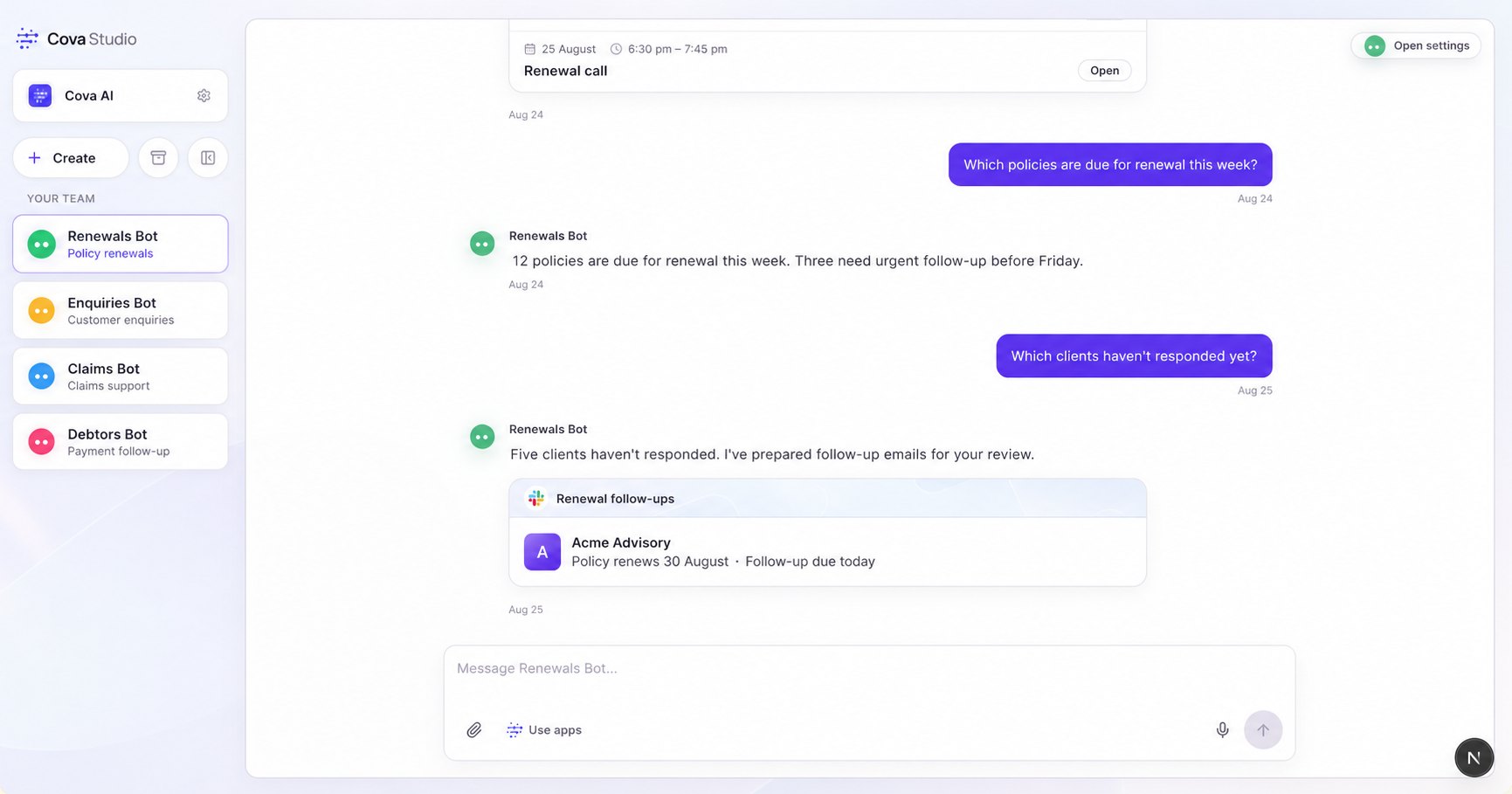
For the past few years, most business AI has followed a familiar pattern. You ask one assistant a question, it gives you an answer, and the conversation ends.
That model is useful, but it is not how real teams work. Work is continuous. A new lead arrives, a client replies, an underwriter sends terms, an invoice is paid, or a renewal moves to its next stage. Each event changes what needs to happen next.
We believe the next phase of AI will move beyond one general-purpose assistant. The future is a coordinated team of specialist agents, each with a clear role, approved tools and relevant knowledge. That is why we are building Cova Studio.
From one assistant to an AI team
Cova Studio is designed to let an organisation create agents around the work it actually performs. A renewals agent might understand upcoming renewals, client responses and outstanding market terms. A lead agent might monitor new enquiries, prepare a response and keep the CRM current. A debtors agent might turn an aged debtors report into individual follow-ups and track what happens next.
These are not disconnected automations. The goal is to give each agent enough context to understand its responsibility, while keeping its access, tools and actions clearly defined.
The future is not one bot trying to do everything. It is a team of specialist agents that can work alongside your people and each other.
What internal testing has shown us
We are already testing Studio internally, and some of the most impressive results have come from relatively simple tasks. These are not futuristic demonstrations. They are ordinary pieces of work that happen every day and consume a surprising amount of time when repeated across a team.
Responding to incoming leads
An agent can review new enquiries from an approved source, triage them, prepare an appropriate response and add the relevant information to the CRM. It can identify which enquiries need a person immediately, which require more information and which can move to the next stage.
The value is not simply a faster first response. It is a more consistent process where fewer opportunities are overlooked and the CRM reflects what has actually happened.
Following up debtors
We have tested agents that take a debtors report and prepare a tailored email for each outstanding account. The agent can monitor replies, mark accounts off as they are resolved and bring disputes or unusual responses back to the team.
A person still controls the process and the appropriate tone, but the repetitive preparation and tracking no longer need to dominate their day.
Keeping renewals moving
Renewals are a good example of why awareness matters. A renewals agent should understand more than a date in a list. It should know whether the client has replied, which documents are outstanding, whether the risk is being remarketed and which underwriters have provided terms.
You could ask, "Who do I need to chase today?" and receive a useful answer based on the current state of the work. During remarketing, you could ask the agent to summarise terms received from three underwriters, identify material differences and follow up the remaining market before the deadline.
This is where multi-agent systems become much more valuable than isolated prompts. The work has memory, ownership and a next action.
Studio is relevant to underwriters too
The same approach can support underwriting teams. An agent can review submissions received from brokers, prepare a risk summary, check for missing information and compare the submission against approved appetite and product knowledge.
It can help a team prioritise complete, in-appetite opportunities while drafting questions for submissions that need more detail. External communication and underwriting decisions can remain subject to human review, with the agent focused on preparation, consistency and speed.
Channels bring people and agents together
Studio will also introduce shared channels where teammates and agents can work together. A channel could be organised around renewals, claims, client service, submissions or another recurring area of responsibility.
People can ask questions, add context and see the same responses. Agents can contribute within their assigned roles, and the whole team can see how the work is progressing. Instead of valuable context being trapped in one person's private chat, it becomes part of a visible team workspace.
Power needs clear boundaries
Giving agents access to business systems and information creates real responsibility. Studio is being built around defined purpose, approved tools, scoped knowledge, visible activity and human oversight.
Cova's AI management system is independently certified to ISO/IEC 42001:2023. The lessons for us going through the preparation, certification, and audit really apply here, and we think this puts us in a great position to deliver a product that has the right guard rails and observability to make sure it's being developed and adopted responsibly.
Early access is coming
Cova Studio is still in development, but we will begin rolling it out to a small group of early testers soon. We want to work closely with teams that have real, repeatable problems and are prepared to help us learn where specialist agents create the most value.
We will also be hosting webinars to demonstrate Studio, share what we are learning from internal testing and explore practical multi-agent use cases for brokers, underwriters, networks and other professional teams.
If you are interested in joining the early testing program or attending an upcoming webinar, explore Cova Studio and speak with our team.