The Broker of the Future: What Happens When Your Assistant Can Actually Do Things
The next generation of insurance brokers will not work harder. They will work with AI agents that can execute tasks in parallel, manage renewals, chase debtors, and prepare client communications while the broker focuses on relationships.

Something is about to change
For the last two years, AI in insurance has mostly meant one thing: asking questions and getting answers. Upload a policy document, ask what the excess is, get a response. Useful, sure. But it still requires you to do everything else yourself.
That is about to change in a big way.
The next phase of AI is not about answering questions. It is about doing work. Real, tangible, time-consuming work that currently eats up your day.
From assistant to agent
Today, most AI tools are reactive. You ask, they respond. You prompt, they generate. The human is always in the driver's seat, always initiating, always reviewing.
AI agents are different. An agent can take a goal, break it down into steps, and execute those steps autonomously. It can make decisions along the way, handle edge cases, and come back to you with completed work rather than suggestions.
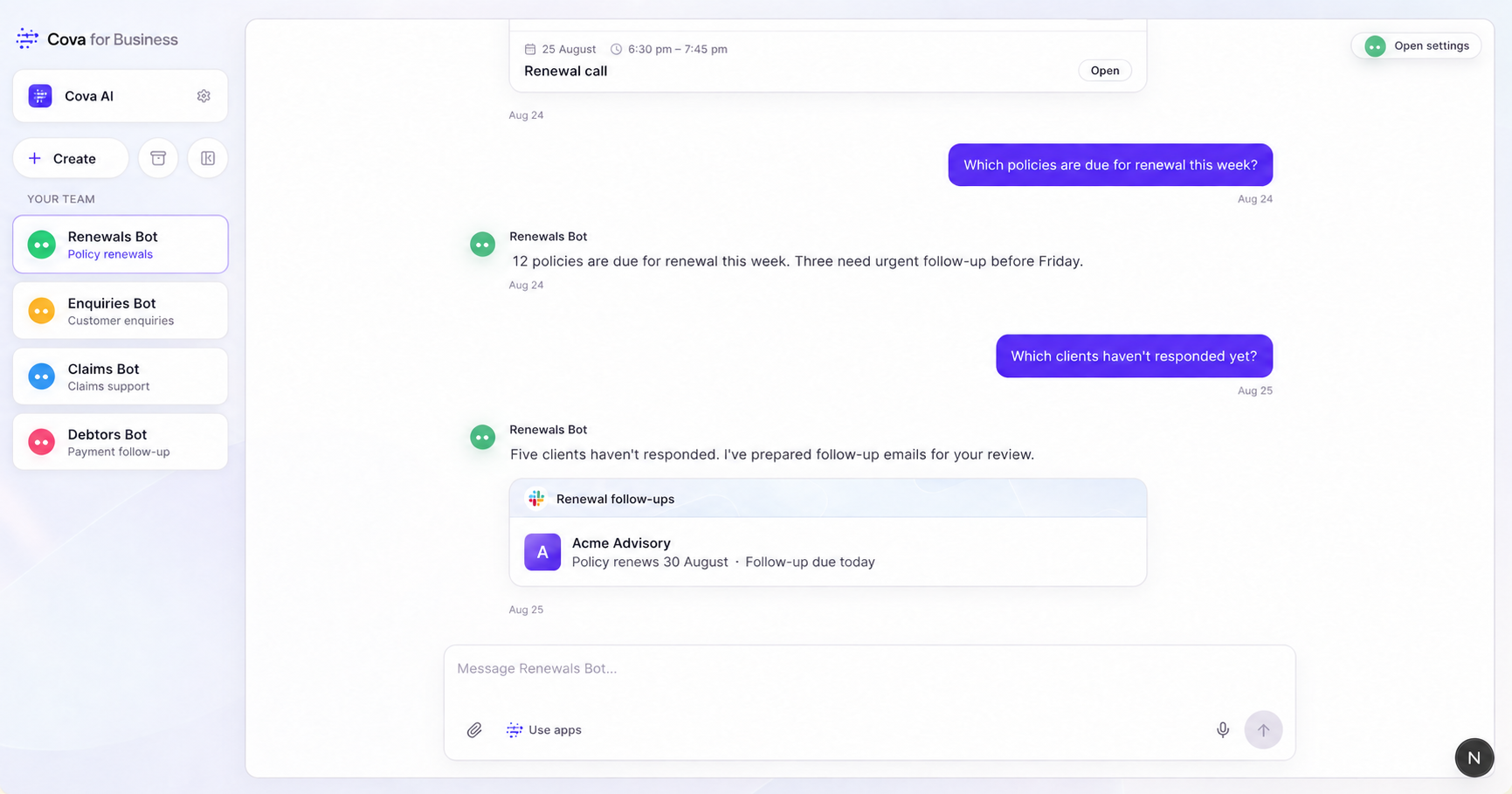
This looks like, instead of spending your Monday morning writing 20 pre-renewal emails one by one, you tell your agent: "Prepare renewal outreach for every client renewing in the next 45 days. Use their policy details, claims history, and any notes from our last conversation. Draft each email personally. Flag any clients where the premium has increased more than 15% so I can call them instead."
Then you go make a coffee. When you come back, 20 tailored emails are sitting in your drafts, ready for a quick review and send.
Parallel work changes everything
The real power of agents is not just automation, it's creating parallel tasks. As a broker no matter how good we are at multi-tasking, realistically we can only do one thing at a time. an agent, for example, can do twenty.
Imagine your morning routine looks like this:
"Send a reminder SMS to all clients with outstanding invoices over 30 days"
"Pull together a summary of every new lead that came in this week with their enquiry details"
"Check which policies are up for renewal next month and flag any that need market submissions"
"Draft a LinkedIn post about our new commercial property offering"
You speak these into your phone on the drive to the office. By the time you sit down, the SMS messages have been sent, the lead summary is in your inbox, the renewal list is ready, and a draft post is waiting for your approval.
What the broker of the future actually does all day
We believe the broker of the future is not disrupted, they are liberated, in a hybrid model that allows them to seamlessly blend real help, supported by digital tools that streamline both their, and the customers experience.
When you remove the hours spent on data entry, email drafting, document chasing, invoice reminders, and renewal admin, you're left with more time to do the work that really moves the needle:
Sitting with a client and genuinely understanding their risk
Negotiating with underwriters on complex placements
Spotting gaps in coverage that a less attentive broker would miss
Building relationships that turn one policy into a whole book of business
Advising on risk management, not just policy selection
Advocating for claims outcomes that improve customers lives.
As brokers we know this is where our value lies, and we already deliver this to an exceptional standard, but we do this amongst balancing the administrative spaghetti soup, but we put a huge amount of hours in to achieve this. We believe in a future where work life balance becomes the norm, rather than the exception.
Your phone becomes your back office
At Cova, we have been building towards this future. Our mobile app already lets brokers ask questions, record meetings, and access client information on the go. But the next step is bigger.
When the Cova Agent is available, you'll be able to talk to it like you would talk to a capable team member. Not just "What is the excess on this policy?" but "Prepare everything I need for my meeting with John at 2pm. Pull his policy details, recent claims, renewal timeline, and any outstanding invoices. Put it in a brief I can glance at in the car."
Or after a client meeting: "I just met with Sarah from Bay Electrical. She wants to add cyber cover and increase her PI limit. Start the process. Get quotes from our preferred markets and send her a summary of options by Thursday."
The agent listens, understands the context, and gets to work.
The trust question
Of course, none of this works if brokers do not trust the AI to get things right. And that is a reasonable concern.
The answer is not blind trust. It is the right level of oversight. Agents should handle the preparation, the drafting, the research, and the coordination. The broker reviews, approves, and makes the final call. Over time, as confidence grows, the review step becomes lighter. But the broker always remains in control.
This is exactly how you would work with a good junior team member. You would not check every comma in every email. But you would want to see the important stuff before it goes out. The same principle applies to AI agents.
It is closer than you think
If you are reading this and thinking it sounds like something five or ten years away, it is not. It's something we've been working on at Cova for quite some time and now in final stages of testing. The Cova Agent launches in the coming weeks, we're excited to see what you can do with it.